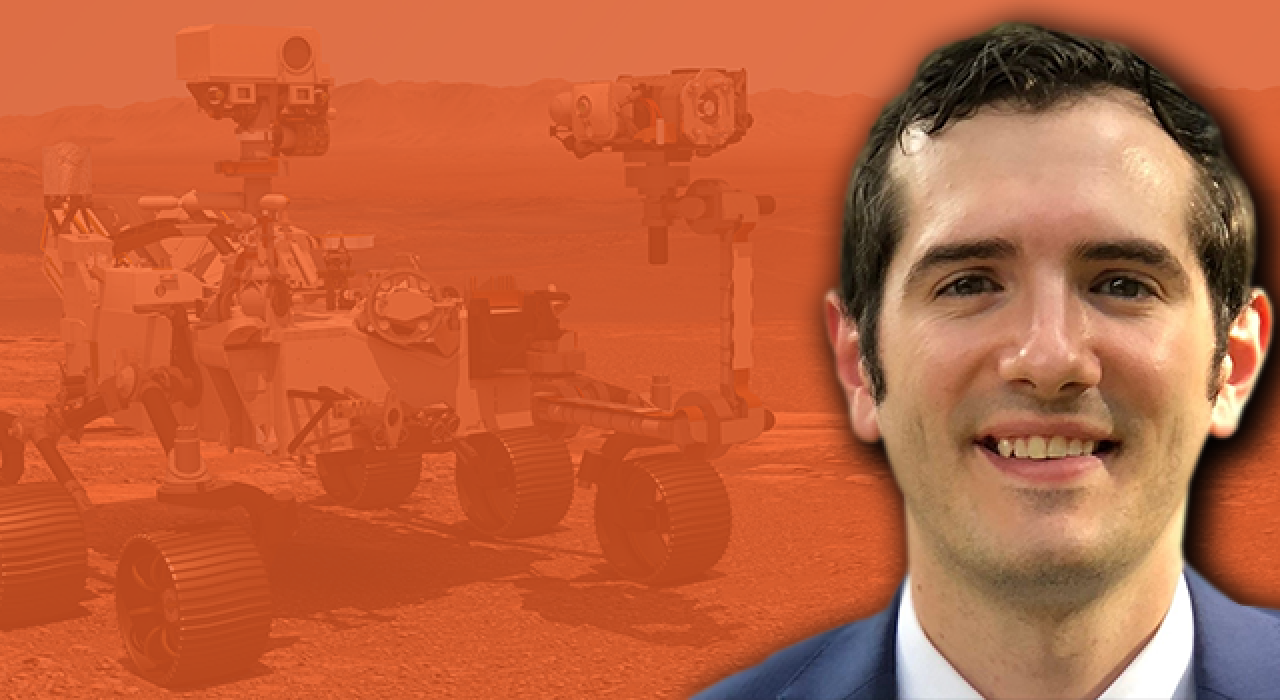
FEBRUARY 25, 2021 — UTSA’s vision to become a premier national research institution will soon get a blast in that direction thanks to important hypersonics research taking place on campus. Under the direction of Chris Combs, Dee Howard Endowed Assistant Professor in Aerodynamics in the Department of Mechanical Engineering, UTSA is nearing the completion of a state-of-the-art, multi-million-dollar wind tunnel funded by the university.
Officially known as the UTSA Mach 7 Ludwieg Tube, the device will be able to conduct hypersonic-related research with speeds over 2,500 miles per hour. Combs’s expertise in hypersonics has recently generated inquiries from the media to comment on how this science impacts NASA’s current mission to Mars and the landing of the Perseverance rover.
“It’s hypersonics. That’s what’s involved with making this landing happen and that’s the type of research we specialize in with my hypersonics lab at UTSA,” Combs said. “So when any kind of spacecraft coming from Earth hits the Mars atmosphere, it’s moving at hypersonic speed, which creates several challenges entering an atmosphere that fast, which is compounded by the significantly thinner atmosphere of Mars compared to Earth.”
“(We) can help understand all the variables involved with landing and with launching a spacecraft from Mars.”
Combs’ research in hypersonics will soon take a Mach-speed leap forward with the completion of the Ludwieg Tube. This highly-advanced wind tunnel will feature some unique capabilities that will distinguish it from similar tubes in the United States. First, it will be used to test a variety of conditions with speeds up to Mach 7, which is seven times the speed of sound. Combs and his research team will test conditions related to hypersonic and supersonic flows, aerodynamics, turbulence, energy and propulsion. Data from this research is of great interest to NASA and the U.S. military.
Another unique feature of UTSA’s Ludwieg Tube is the ability to mimic various atmospheric conditions including a mix of gas that comprises the atmosphere of Mars.
“In doing that you can help understand all the variables involved with landing and with launching a spacecraft from Mars,” Combs said. “One of the reasons we’re building this wind tunnel is to be able to study these environments and help improve our understanding of the physics at play, so future spacecraft can be more efficiently designed.”
The Ludwieg Tube Mach 7 is nearing completion. Ironically, it was the Earth’s atmospheric conditions that caused a delay. February’s polar vortex in San Antonio kept crews from working on the project, pushing it out a few more weeks.
“It’s undergoing final assembly and we’re targeting the end of the spring 2021 semester to have it complete,” Combs predicted.
As part of UTSA’s Classroom to Career strategic initiative, Combs’ students will gain valuable experience working directly with the Mach 7 wind tunnel, which could attract more students to pursue degrees in aerospace engineering, which are in strong demand to support a growing aerospace industry in San Antonio and the nation.
As a scientist and space travel enthusiast, Combs understands what’s at stake through hypersonics research with missions to Mars and beyond.
“There’s something in the human DNA to explore, to branch out, to see what’s out there, and Mars is the next logical step.” said Combs. “If civilization is going to outlive Earth or problems we create on Earth, we need to develop the capability to get off the planet and get to another planet—probably get to other solar systems. But you know, one thing at a time.”