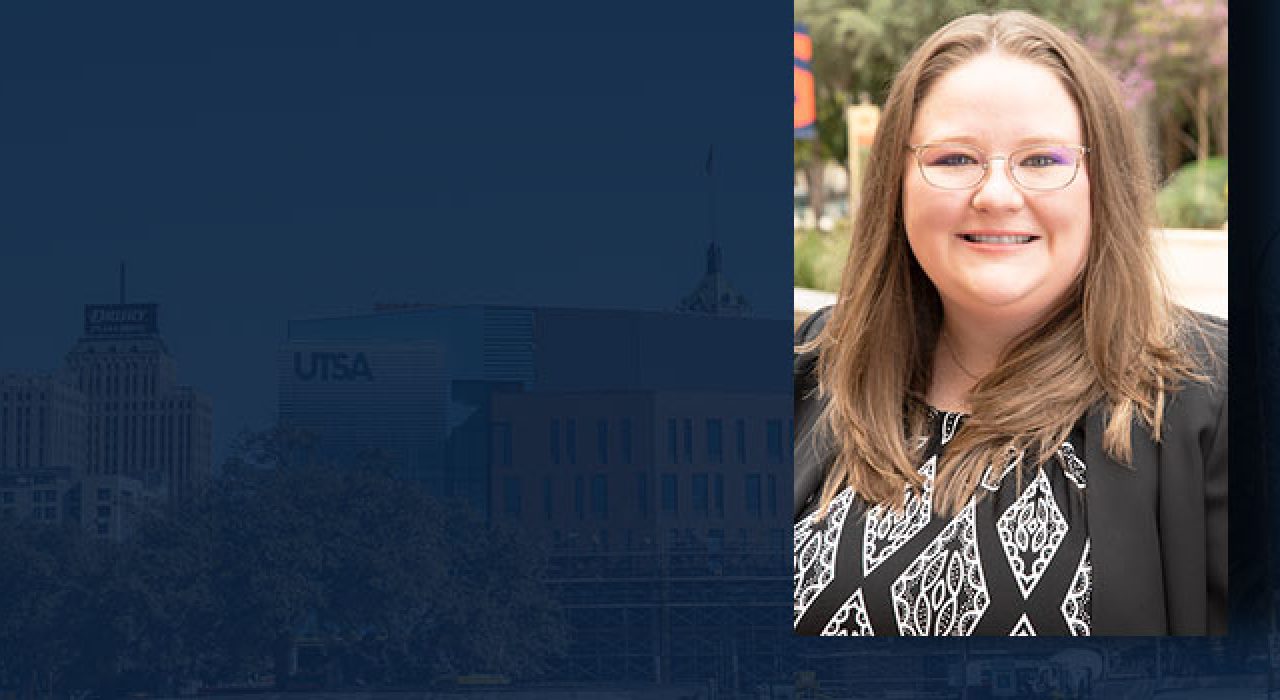
Data science can be applied to all academic disciplines, so Rebecca Schroeder, associate professor of instruction in the UTSA University College, is working to eliminate the barriers students encounter accessing the world of data science.
Schroeder is slated to join UTSA’s new School of Data Science as a core faculty member when it opens its doors to students in January. But she’s already fostering students’ interest in the field.
The UTSA professor is among a group of faculty members who are developing transdisciplinary lessons that will enable students to combine their existing coursework with artificial intelligence (AI), data analytics and data visualization through the UTSA Generation AI Nexus program.
The professors are working with MITRE, a not-for-profit corporation dedicated to research and development in the public interest, to help other UTSA faculty members develop and incorporate AI lessons in marketing, geological sciences, psychology, biology and business courses.
“We’re transforming existing curriculum to include a data science aspect so that students actually see what data science is and get to interact with some data sets.”
“We’re transforming existing curriculum to include a data science aspect so that students actually see what data science is and get to interact with some data sets,” Schroeder said.
Political science students, for example, can explore data analysis by analyzing information about federal election campaign donations. Environmental science students can study the environmental impact of discriminatory lending practices from the new-deal era have by looking at Redlining data.
UTSA is also introducing the effort in its Academic Inquiry and Scholarship (AIS) course, a core curriculum class required for all first-time freshman and students entering the university with less than 30 hours. AIS students are grouped according to common majors. Pairing data science with curriculum within the AIS pathways, Schroeder noted, has amplified students’ experiences and provided them with the opportunity to become acquainted with the world of data science.
“Being able to show them that it can fit into their world is important. They don’t often know that they could be a philosophy major and get a certificate in data science, pair those together and be an attractive candidate in the workforce. They have this flexibility to really tailor it to something that interests them,” Schroeder said.
In addition to the multidisciplinary studies in data science, students can also pursue a Bachelor of Arts degree in applied data science, where they can blend data science into one of three subjects of their choice including cyber intelligence, digital humanities or political science, again allowing students to integrate data science into their interests.
“A lot of students come in with fears and insecurities but giving them this path of the B.A. of data science has eliminated a lot of the common barriers students encounter. It’s been amazing to see the application of data science into so many diverse fields and see the students grow in that aspect,” Schroeder said.