

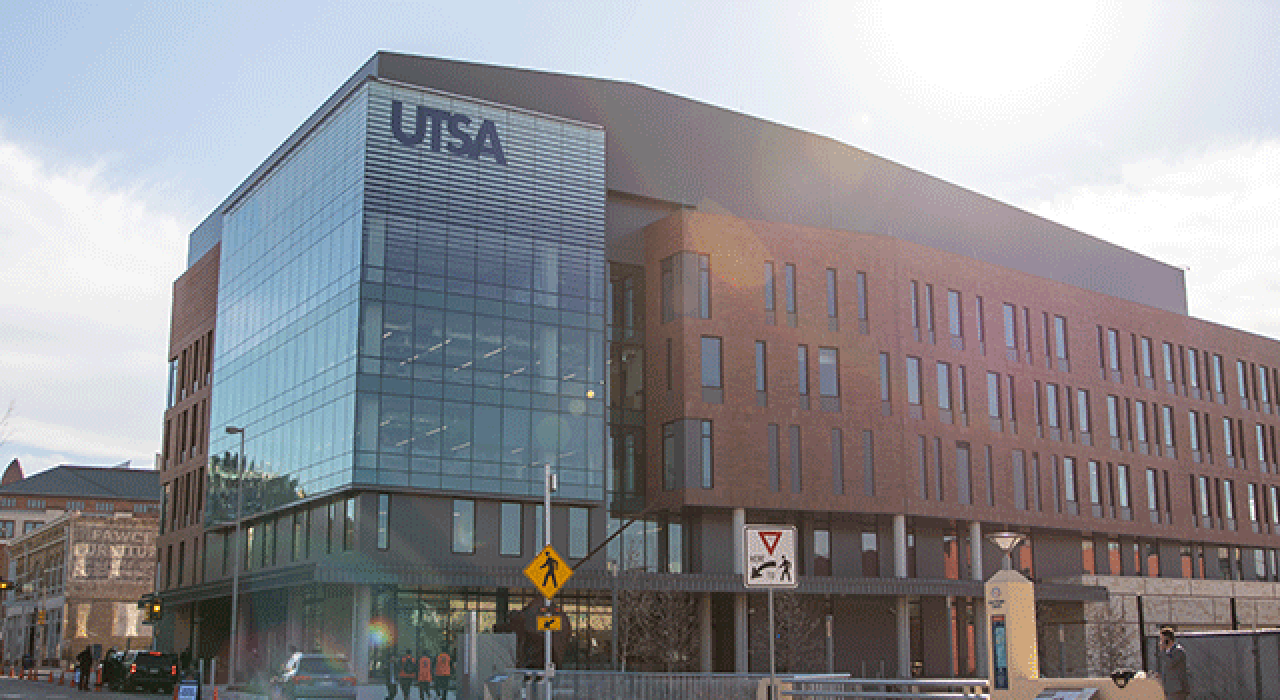
UTSA students recently had the unique opportunity to see how intelligence officials are keeping the country safe from cyber-attacks when they attended the 2024 Intelligence Community Centers for Academic Excellence (IC CAE) Principal Investigators Development Summit.
The three-day conference gathered faculty members, intelligence professionals and students at the San Pedro I Building in downtown San Antonio.
The inclusion of students was a deviation from past summits, said Max Kilger, professor of practice with joint appointments in management science and statistics and information systems and cybersecurity.
“It’s really great for our students, not just our IC CAE students but all UTSA students who have the opportunity to meet with recruiters, talk to them, and get recruiters interested in them.”
“It’s unusual that students get to see any of this conference at all,” Kilger said.
However, this year’s summit featured multiple opportunities for students to engage, network and present their work. IC CAE students also had a chance to meet with the Director of the National Counterterrorism Center Christine Abizaid, Kilger noted.
“Their meeting was scheduled for 30 minutes, and it went over an hour, so it was very successful,” he said. “The students were just on cloud nine and I talked to the director, and she was very impressed with them.”
This year’s conference was hosted by The Office of the Director of National Intelligence (ODNI) and the UTSA National Security Collaboration Center (NSCC), which is housed in San Pedro I.
ODNI established the IC CAE in 2005 to promote the development of highly qualified intelligence professionals by providing grants to various universities. UTSA became an IC CAE university in 2018, when it was awarded a three-year, $2 million dollar grant to create its own IC CAE program.
Although the grant expired in 2021, UTSA retains its IC CAE designation and is considered a legacy school — becoming the first legacy school to ever host the summit.
Over 120 faculty members, U.S. Intelligence Community (IC) professionals and students attended this year’s conference, said Kilger, who serves as the director of the IC CAE program at UTSA.
Some students were also invited to present at the conference, including students of Paul Rad, associate director of research for the UTSA School of Data Science and associate professor of computer science. Rad’s students presented research relevant to national security, including research in the areas of artificial intelligence, large language models and deep learning.
In conjunction with the summit held at SPI downtown, ODNI and the Carlos Alvarez College of Business co-hosted a federal hiring event on the UTSA Main Campus, featuring recruiters from a variety of IC organizations and agencies. Prior to the hiring event, students had the opportunity to attend a workshop on the Main Campus to help them prepare their résumés and enhance their interview skills.
The workshop and hiring fair provided a fantastic opportunity for students interested in learning more about careers in the intelligence community, Kilger said.
“It’s really great for our students, not just our IC CAE students but all UTSA students who have the opportunity to meet with recruiters, talk to them, and get recruiters interested in them,” he said. “It’s a fabulous thing for students.”
He attributed the success, in part, to the number of intelligence agencies in the San Antonio area.
It also helped that the event was held at San Pedro I — home to the School of Data Science, the NSCC and more than 70 faculty members from the university’s departments of Computer Science, Computer Engineering, Statistics and Data Sciences, and Information Systems and Cyber Security.
Kilger acknowledged the importance of NSCC’s support, both for the event and as a resource for IC CAE students.
“The NSCC is a huge resource for our students. There are embedded members of the IC in the NSCC, and there are opportunities for students to talk to them, and some of them have mentored some of our students,” said Kilger. “Our program has a very nice symbiotic relationship with the NSCC which really benefits our students.”


