

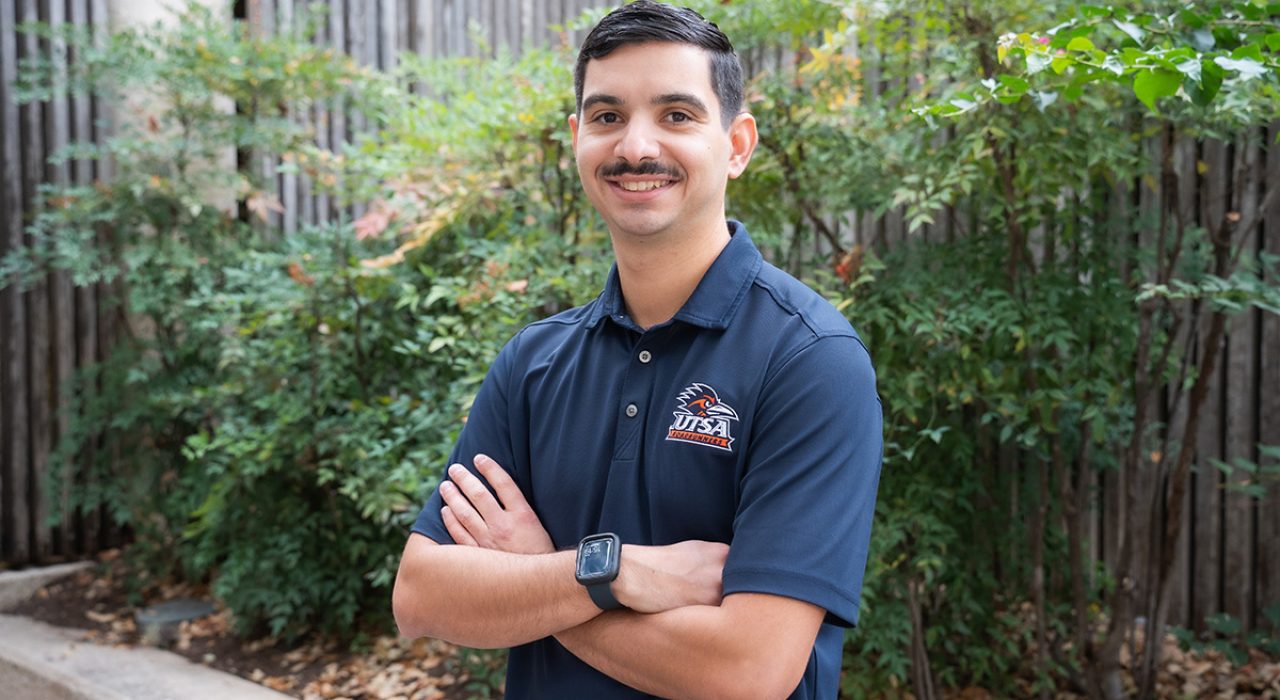
UT San Antonio Fall 2025 Commencement ceremonies are Dec. 15. This story is one in a series about the university’s outstanding graduates.
In his 20s, Julian Hernandez earned a degree in telecommunications and broadcast journalism before embarking on a career in Florida newsrooms as a reporter and producer.
At first, the work was fast-paced and rewarding for the Miami native. Eventually, the industry no longer offered the sense of direction he had expected. ‘“It just was not waking me up every day,” Hernandez said.
In December, Hernandez graduates with a master’s degree in history, a stepping stone to a new career that combines his lifelong interests.
Hard look
After Hernandez’s mother died in 2018 at age 57, it pushed him to reassess his own path. “Seeing her make so much of her years made me take a hard look at mine.”
The reflection led him to long-considered plans for military service. In 2019, he joined the Army as an infantryman.
He served with a unit based in Europe and deployed to Africa during that time, then returned to Europe for further assignments that included work in support of NATO operations.
The experience was challenging and far removed from his previous work, and it offered renewed purpose.
“Some lessons are only taught at the school of hard knocks,” Hernandez said.
Another calling
While on guard duty overseas, Hernandez began thinking about what should come next. The routine brought him back to the passion he had carried since childhood.
Hernandez had always gravitated toward stories, first as a journalist, then as a soldier.
Deployment led him to consider another calling. “History had always been my passion,” he said. With support from veterans benefits, he felt ready to pursue the degree he had set aside years earlier.
After returning stateside, Hernandez accepted a civilian public affairs position with the Department of the Air Force at Joint Base San Antonio-Lackland.
He enrolled at UT San Antonio and was soon selected for the Nau Scholars Program, a selective scholarship funded by the Nau Foundation to support promising history students. The program offered early guidance and helped him build connections within the history department at UT San Antonio.
His master’s thesis, “Occupying the Republic: The US Army, Counterinsurgency, and the Unfinished Work of Reconstruction,” examines the Army’s role in the former Confederate states after the Civil War. The work draws on archival sources and considers how 19th century occupation relates to modern military practice.
Conducting the research required extensive work with historic manuscripts at the National Archives.
“Some of these documents felt like cryptography,” he said. Others were so delicate that turning a page felt like handling a relic. “It was an incredible feeling. I was probably the first person to read some of these pages since they were written 150 years ago.”
Hernandez hopes readers take from his research the idea that earlier eras can reveal unexpected insights about later ones.
“Historical actors can display traits and experiences from periods not typically associated with them,” he said. “History does not fit in neat boxes and there is so much we can learn from the past to better inform how we do things today.”
Measure of perseverance
Balancing full-time public affairs work with graduate study required discipline. Hernandez managed to maintain strong academic performance and remained committed to the demands of the program. He is on track to graduate with a 4.0 GPA, an accomplishment he views as a measure of his perseverance.
Hernandez hopes to build a career that brings together his historical training with both his communications and military experience.
He is drawn to roles within the Department of Defense that focus on research or the preservation of institutional history. Teaching also appeals to him since he sees the classroom as a space where he can share his enthusiasm for the field and help students explore their own interests.
Asked what guidance he would offer students facing major transitions, Hernandez reflected on the mindset that carried him through his own.
“You have to stick to your guns,” he said. “Life will try to divert your path. If you put in the work, you can find a way to wherever you want to go.”


