

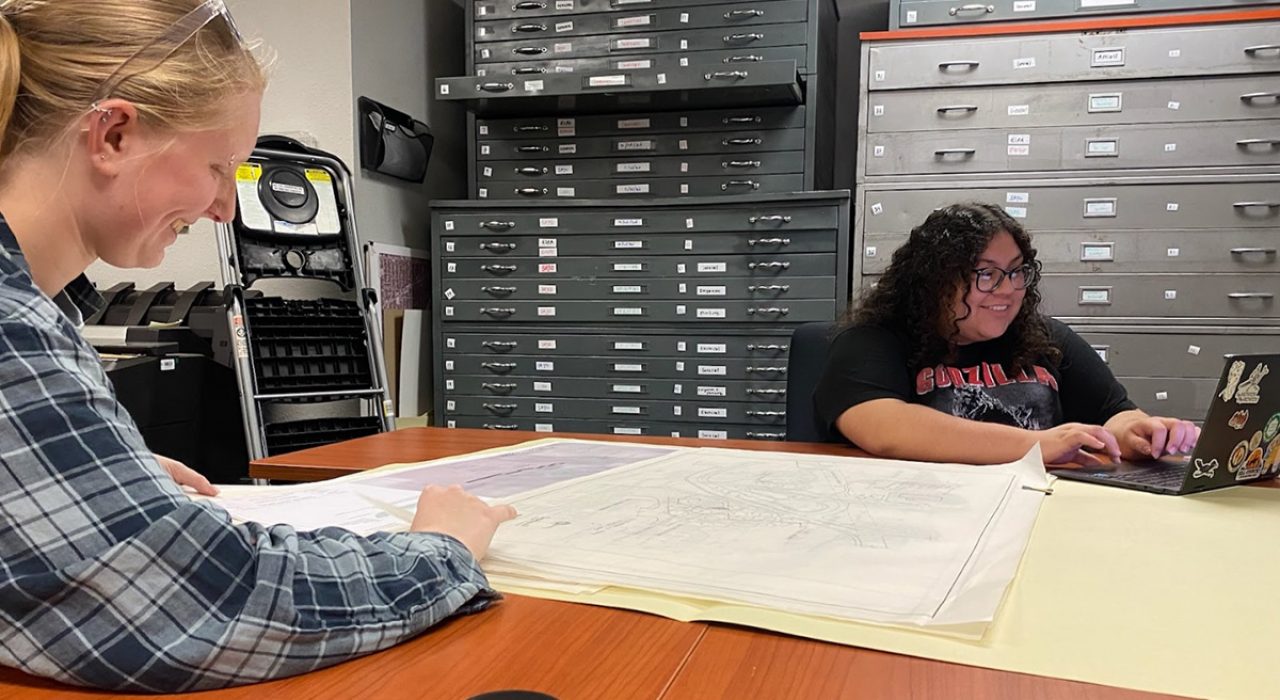
A new initiative by the UT San Antonio Libraries is transforming how students learn about cultural preservation while broadening access to historical collections.
Preserving Archives of Texas Heritage (PATH) is a program teaching the university’s students to work directly with archival materials, digital collections and GIS mapping, and work with community organizations to document their histories.
Launched in 2025, PATH was founded through a partnership between the Texas Heritage Project (THP) of American Indians in Texas-Spanish Colonial Missions (AIT-SCM), UT San Antonio Libraries’ Community Engaged Digital Scholarship Hub (CEDISH) and the San Antonio Missions National Historical Park.
PATH interns have the opportunity to gain hands-on experience in archival processing, digital preservation, map interpretation and public history.
Students learn directly from tribal leaders, park professionals, librarians and faculty, while contributing to projects that improve access to historic maps, documents and records across South Texas. Cohort-based workshops introduce interns to federal cultural resource law, GIS tools, collections care and ethical stewardship frameworks shaped by Indigenous perspectives.
The PATH program also connects local organizations, students and scholars in a shared effort to preserve and communicate the diverse history of South-Central Texas, said Rebecca Bria, assistant professor of anthropology, who works with PATH interns.
“Each PATH student intern contributes a unique perspective that enriches this work and supports our community partners’ mission,” Bria said.
In one recent project, PATH interns worked with the Wilson County Historical Commission to digitize and geo-reference more than 100 historic maps. Students transformed aging paper maps into interactive GIS layers, allowing users to trace how land ownership and settlement patterns have changed over time.
The project not only preserved fragile materials but also produced tools the county now uses to guide development and protect historically significant sites.
The initiative developed organically, said Veronica Rodriguez, UT San Antonio Libraries head of digital humanities and user engagement and PATH program lead. “We started with conversations about how we could support THP’s mapping and archiving work,” she said. “PATH became a way to link our students with that mission through the digital scholarship hub.”
The PATH program’s approach reflects a guiding principle of CEDISH — that digital scholarship should be rooted in genuine community relationships.
Over the years, the hub has emphasized long-term collaboration, trust-building and listening to partner needs — ensuring that projects are shaped not solely by academic goals but by the priorities of the communities whose histories are being documented.
That philosophy forms the foundation of the PATH program’s work.
Since 2015, Rudy De La Cruz, project director of the Texas Heritage Project, has supported and facilitated the initiative’s community partnerships. De La Cruz said he sees PATH as a natural continuation of a decade-long effort to build respectful, reciprocal relationships between UT San Antonio and the region’s cultural organizations.
“When you put students on the ground with community members, something changes,” he said. “They begin to see history not as something distant, but as something living — something people care about, safeguard and rely on.”
Interns describe the experience as transformative.
“The PATH Program gave me the opportunity to apply the GIS skills I learned in the classroom to meaningful, real-world heritage preservation projects with the AIT,” said PATH intern Lauren Nowakowski. “This experience strengthened my professional credentials and helped me secure future internships that built upon the knowledge and skills I developed through the program.”
H. Walker-Tamboli, who worked as an intern for three semesters, said the supportive environment and variety of assignments — from digitization and oral history to georeferencing and digital exhibit creation — prepared them for a career in archives and helped them understand how nonprofit organizations use archival research to advance social, political and cultural goals.
Rodriguez notes that this combination of mentorship, technical training and community impact is what makes the program distinctive. “Students are not just processing materials — they’re learning how preservation work supports living communities and shared heritage,” she said.
By the end of this year, PATH is expected to have processed and digitized more than 400 historic maps, created public-facing digital tools, supported over 16 interns, and built replicable documentation models that can be used by cultural institutions across the region.
The PATH team plans to expand the program to additional collections and historic sites, strengthening pathways for students entering careers in archives, museums, GIS and public history.
“Community work moves at the speed of trust,” Rodriguez said. “But that’s what makes it meaningful.”


