


As modern society grows more dependent on satellites for navigation, weather forecasting, communications and national security, protecting these space assets from cyber threats has become a critical priority. Recognizing both the urgency of the challenge and Texas’ emerging role in the national security space landscape, The University of Texas at San Antonio is stepping forward to help shape a coordinated statewide response.
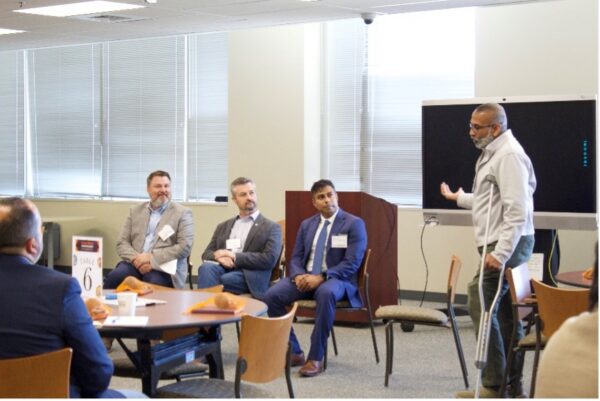
The university convened researchers, industry partners and federal agencies from across the state for the inaugural Texas Space Cybersecurity Workshop in February.
The two‑day event, hosted by the UT San Antonio Office for Research and Innovation, the National Security Collaboration Center (NSCC), the Institute for Cyber Security (ICS), and the Center for Space Technology and Operation Research CSTOR, served as the catalyst for a broader effort: building a long‑term, Texas‑wide network dedicated to securing space systems.
“Space systems underpin nearly every aspect of our daily lives,” said David Silva, PhD, director of CSTOR. “Texas has the research capacity, industry presence and operational experience to lead in this domain. UT San Antonio is committed to bringing those partners together to address challenges that affect the entire nation.”
A statewide research community takes shape
The event served as an early step in UT San Antonio’s efforts to develop an enduring community of practice that brings together universities, operators, government agencies, and industry partners.
Thirteen institutions participated in the workshop, representing a broad cross section of Texas higher education — including Baylor University, Prairie View A&M, Rice University, Texas A&M University, Texas State University, Texas Tech University, the University of Houston, UT Austin, and UT Rio Grande Valley in addition to industry and federal partners such as Blue Origin, Booz Allen Hamilton, Sandia National Laboratory, Southwest Research Institute,, Texas Cyber Command, and the U.S. Space Force.
The diversity of participants reflected a central premise emphasized throughout the discussions: expertise developed in traditional cybersecurity areas can be directly applied to protecting satellites and space ground systems.
Many of the vulnerabilities faced by orbiting assets mirror those found in terrestrial networks, but with higher risks and fewer opportunities to patch or repair once equipment is in orbit, explained Silva.
“Our aim is to collaboratively address the challenges facing operators, researchers and policymakers, to fill research gaps and to expand the workforce pipeline to meet national and commercial needs,” he added.
San Antonio’s unique role
San Antonio’s longstanding leadership in cybersecurity makes UT San Antonio a natural hub for this effort. The city’s strong ecosystem — which includes federal agencies, military missions, research institutes and private sector partners — positions the university to convene stakeholders who often operate in separate domains.
The university’s research centers NSCC and ICS bring together applied research, operational partnerships, and advanced testing capabilities that help bridge the gap between academic innovation and real-world needs.
“San Antonio already serves as a national cybersecurity center, and UT San Antonio is the natural leader to extend that strength into the space domain,” said David Brown, executive director of the National Security Collaboration Center. “We are working actively with our mission partners to meet emergent national security priorities and challenges.”
During the event, discussions addressed the current threat landscape, the growing complexity of satellite networks and the evolving needs of operators across commercial, civil and national security space sectors. Several universities demonstrated that Texas researchers are already working on challenges relevant to space cybersecurity — from network security and cryptography to system resilience and intrusion detection — even if their work was initially developed for terrestrial systems.
Looking ahead
UT San Antonio is positioning itself as the central hub for Texas space cybersecurity research, creating a structure for ongoing collaboration, shared initiatives and future joint projects that extend well beyond the two-day event.
The momentum generated by this initial gathering reflects a shared commitment to safeguarding the orbital infrastructure that modern life increasingly depends on.
“Protecting satellites is not just a technical challenge — it’s a strategic one,” Silva added. “By building this network now, Texas can help shape the future of space security and strengthen the nation’s resilience.”


