


Architecture major Daniel Hernandez had pored over years of public housing move-out data, but it wasn’t until he was standing inside an Opportunity Home San Antonio affordable housing community that the true scope of his work washed over him. During these site visits, the spreadsheets and data models gave way to the real-life families behind the numbers — the residents who faced housing instability, financial hardship and difficult life transitions.
“Seeing the properties in person helped connect the data to real places and real people. It showed me that the numbers tell a much bigger story than just positive or negative move-outs,” Hernandez said. “They show the challenges people face and the realities of living in public housing, so the visits helped me better understand what the data was actually representing.”
Hernandez is one of 20 UT San Antonio students participating in the H-E-B Community Innovation Scholars program this summer. The summer undergraduate program is a collaborative effort between the College of AI, Cyber and Computing and the United Way of San Antonio and Bexar County.
Open to students from all majors, the program pairs Roadrunners with San Antonio nonprofits to solve real-world challenges through innovative applications of data science and artificial intelligence. Participants gain career-ready skills by helping local nonprofits increase their organizational efficiencies, leverage their collected data and use it to its full potential.
The ‘human side’ of housing data
The Opportunity Home team’s goal is to identify ways to prevent housing instability before families reach a crisis by using database systems and AI automations.
“Not affording rent is not the only reason people live,” said Jose Granados, a computer science major. “The environment also plays a huge part in the reason people leave these properties. Data can tell us why people are leaving public housing and the top reasons for it, and knowing this, we can prevent more of these situations from happening.”
Visiting the properties added context that Hernandez said he could not have gained from a typical classroom assignment or from looking at data alone.
“The experience helped me look beyond the data and understand the human side of the project,” Hernandez said.

The Opportunity Home team quickly tackled complex analyses and showed a level of curiosity, communication and commitment that went far beyond the data alone.
Psychology major Aribah Hussain said her team is gaining hands-on experience in coding, AI systems, geocoding software, teamwork, communication, leadership skills and original, out-of-the-box thinking. She said she is enjoying collaborating with students from different disciplines with diverse skills.
Aiyana Longoria, chief strategy officer for Opportunity Home, said the students exceeded expectations. They quickly mastered the complexities of public housing data while bringing fresh perspectives and genuine curiosity to the project.
“These university students look at our data with fresh eyes and no preconceived biases,” Longoria said.
Closing the gaps
Another team of H-E-B Community Innovation Scholars is working with ABC of Southwest Texas, a nonprofit organization that empowers families of children with special healthcare needs. This collaboration became personal for Kylee Reid, a computer science major who was diagnosed with autism as a child.
“Programs like ABC gave my mom the resources to get me that diagnosis, understand what autism was, and connect me with therapists who could help with my special needs,” Reid recalled. “I know firsthand how important it is for families like mine to be assisted and informed to ensure the safety and happiness of children in need.”
The ABC team is analyzing data to identify service gaps, understand where participants disengage and uncover trends in programs such as autism services and bereavement follow-up.
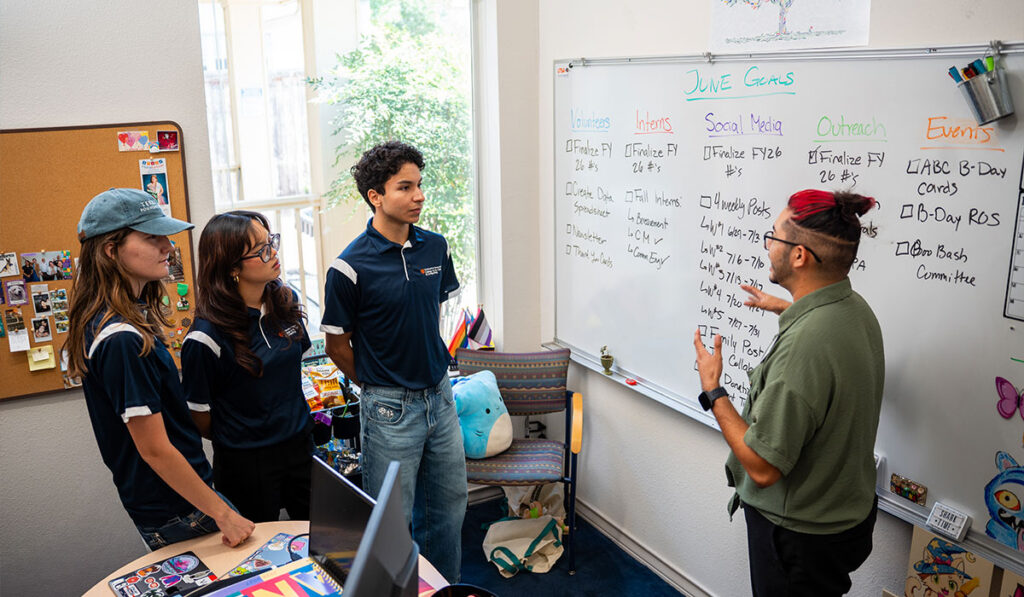
For Lyly Vo, a mathematics of data and computing major, the project is strengthening her ability to work with complex datasets, uncover patterns and ask deeper questions.
“It feels different from a traditional classroom setting or assignment because I know these results can have a real impact on the organization and there are no predetermined solutions to these questions,” Vo said.
By the end of the summer, the scholars hope to deliver a report that provides ABC with deeper insights into the people they support, enabling the organization to better refine and strengthen its outreach strategies.


