


One of artificial intelligence’s most stubborn problems is AI systems being able to accumulate new knowledge without losing what had been previously learned. A team of researchers at the MATRIX AI Consortium at The University of Texas at San Antonio may have solved this issue with Genesis, a spiking neuromorphic accelerator chip that would enable on-device continual learning across its operational lifetime.
Imagine a security drone trained to patrol a dense forest to spot signs of wildfire. After months of honing its ability to identify smoke among pine trees, the drone is reassigned to a coastal region to watch for floods. The moment the drone learns to interpret these new types of images, it might completely lose its ability to detect a forest fire. In the world of artificial intelligence, this phenomenon is known as “catastrophic forgetting,” and it remains one of the biggest hurdles to creating truly intelligent, autonomous agents.

Solving the challenge of “catastrophic forgetting”
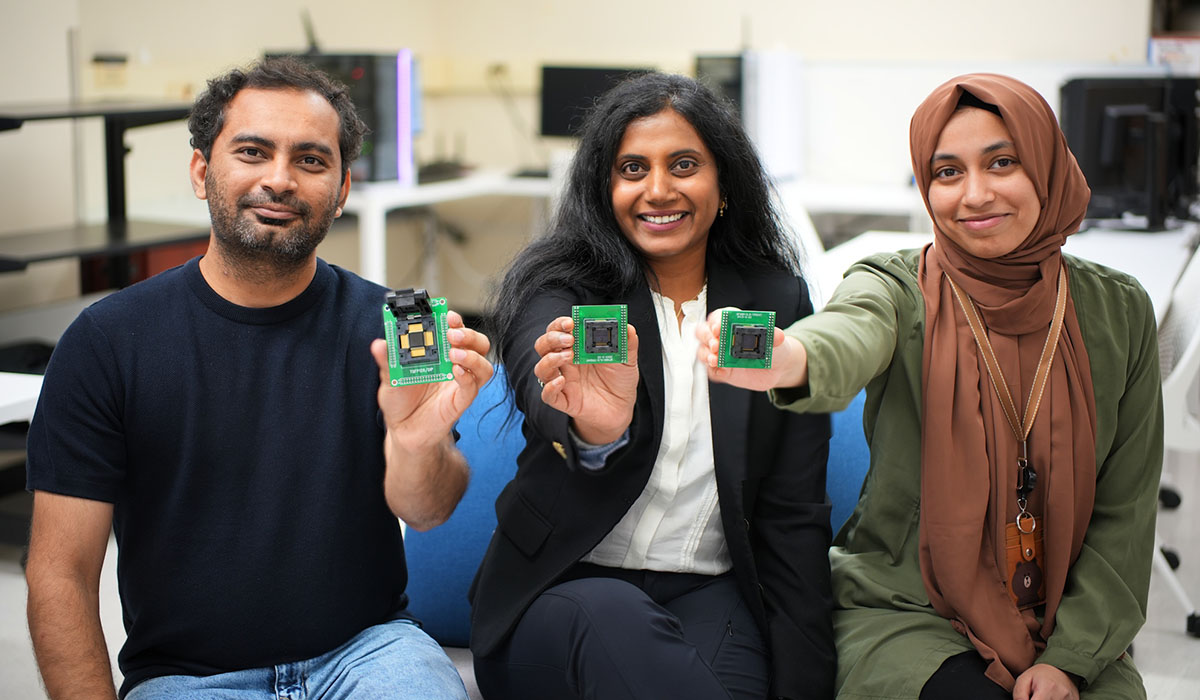
The team led by Dhireesha Kudithipudi, PhD, founding director of UT San Antonio’s MATRIX AI Consortium and the Neuromorphic Artificial Intelligence Laboratory (NUAI) Lab in the College of AI, Cyber and Computing, is designing specialized hardware that mimics the human brain’s ability to learn continually throughout its lifetime.
What sets this work apart is the close collaboration between the team and theoretical and computational neuroscientists who provide a deep understanding of the biological underpinnings of learning and memory used to develop lifelong learning for edge devices and improve neuromorphic computing at scale. Each of these components of research laid the groundwork for the innovative Genesis chip.
Metaplasticity
The human brain doesn’t treat all connections equally, with some synapses, the junctions between neurons, being used so frequently that the brain becomes reluctant to change while others remain open and available for use. This regulation of how readily the brain changes is called metaplasticity, and Genesis is built on this principle, allowing it to learn new things without continuously overwriting old information.
Genesis replicates variants of this on silicon, with each processing element on the chip tracking not just its current use but also its history, how much it has contributed and how often it has fired. High-importance connections resist overwriting. New learning is routed toward what’s still flexible. The result is a system that accumulates knowledge.
Energy savings
Kudithipudi’s team is also utilizing spiking neural networks (SNNs), which process information in pulses or “spikes” similar to biological neurons. When there are no tasks to complete, the system rests. This approach is far more energy-efficient than the standard artificial neural networks used in modern AI large language models (LLMs).
Genesis saves additional power with a custom data movement strategy. In a traditional chip, the movement of data between memory and processors creates a bottleneck that wastes power, but the innovative shortcut in the chip allows it to store and access all the information it needs for learning in one place. While still in the testing phase, the resulting new chip could consume 30 to 100 times less energy than traditional hardware.
Intelligence at the edge
Genesis is designed for the parts of the world where there is no data center or reliable connection to the cloud to offload information. It runs on milliwatts, low enough for implantable medical devices, field-deployed drones, and wearable sensors that need to keep learning for years without a recharge or a reset. It’s designed for real-world uses where the information is cumulative, and the system improves the longer it runs and learns.
The chip didn’t arrive in a single leap. UT San Antonio doctoral students and postdoctoral fellows Vedant Karia, Fatima Tuz Zohora, Abdullah M. Zyarah and Nicholas Soures worked through two earlier prototypes over a five-year period before arriving at the current Genesis architecture. Alongside the hardware, the team developed the learning algorithms, the framework used to understand and scale the AI agent and MetaplasticNet which is a brain-inspired neural network architecture. These components were brought together intentionally to support the chip’s innovative energy efficiency by keeping the power usage low.
“We have spent years building the theoretical and hardware foundations for how systems can learn continuously the way the brain does without erasing what came before,” said Kudithipudi. “Genesis is proof that this isn’t just a concept anymore. UT San Antonio is setting the precedent for students solving these problems by building the actual chips, and I expect more doctoral and post-doctoral scientists to pursue this specialization on our campus.”
UT San Antonio’s growing AI ecosystem
The chips are fabricated through a partnership with SUNY Albany using IBM’s 65nm technology. This research effort is supported by a multi-million-dollar, five-year grant from the Air Force Research Laboratory (AFRL), highlighting UT San Antonio’s growing leadership in AI hardware innovation, semiconductor design and energy-efficient intelligent systems.
Matrix AI and the NUAI Lab’s work at UT San Antonio connects to a broader national push as AI continues to permeate daily life. From medical devices to autonomous vehicles, the Genesis architecture is a major step toward a future where machines can build on what they know over many years like humans, all for a fraction of the energy costs when compared with other AI learning models.
For Kudithipudi, Genesis is not the finish line. The next phase of her team’s work focuses on scaling these mechanisms, readying them for real-world deployment, and integrating them with new hardware and software to push for greater efficiency and capability.


