


From identifying the dangers of emerging street drugs to helping retailers unlock new business insights using artificial intelligence, UT San Antonio graduate students are helping industry and community partners turn complex challenges into practical solutions.
Through the Headache Cure Board, which connects graduate student teams with industry and community partners seeking data-driven solutions to real-world challenges, the College of AI, Cyber and Computing’s Center for Data Science brought together students from multiple disciplines to tackle organizational “headaches” using advanced analytics, AI and research expertise.
Led by center director Anthony Rios, with faculty mentors Min Wang and Ke Yang, the initiative guided student teams on projects ranging from predicting the dangers of emerging street drugs to building a digital platform that expands access to faith-based education and community engagement. The experiential learning program is funded by Federal IT Consulting, LLC (FEDITC), and students are guided by faculty mentors.
Big challenges, smarter solutions
The problems brought to the Headache Cure Board required students to apply their technical knowledge in very different ways. For the U.S. Army Forensic Toxicology Program at Fort Sam Houston, that meant exploring how machine learning could help scientists predict the potential toxicity of emerging street drugs before extensive laboratory data is available.
A multidisciplinary student team worked with Marisol S. Castaneto, PhD, fellow of the American Board of Forensic Toxicology and program manager of the forensic toxicology program. The team analyzed the chemical structures of emerging designer benzodiazepines, a class of sedative drugs, to identify patterns that could signal potential dangers. The research could provide toxicologists, forensic laboratories and emergency responders with an early warning tool to help prioritize which new street drugs require immediate laboratory testing.
“When a new illegal drug hits the streets, forensic labs often have no reference information about it — no data on how strong it is, how long it stays in the body, or how toxic it might be,” said Joel Fry, a Master of Business Administration student. “During that gap, medical examiners, emergency doctors and toxicologists are essentially working blind.”
The team’s machine learning models identified patterns between new drugs and known compounds, providing an early screening tool before laboratory testing.
“Granted, our findings won’t replace the lab, but will provide some triage to help health officials prioritize which [chemical structures] to look at to confirm lethality,” Fry said.
These same technologies took on a different purpose, helping retailers make smarter business decisions with AI support.
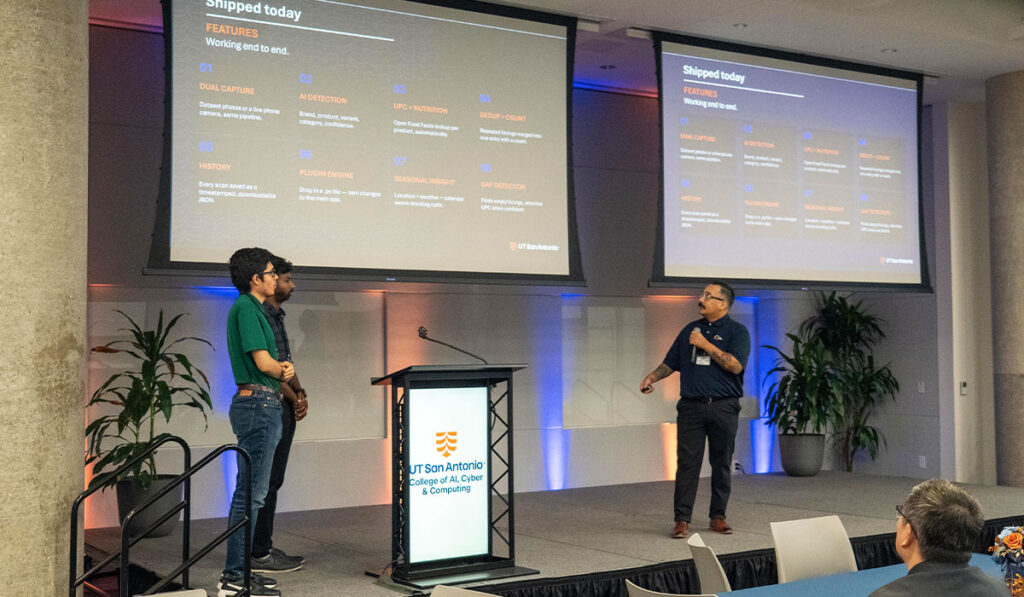
Partnering with Ravi Kanniganti, H-E-B director of AI strategy and innovation, another team developed an AI-enabled retail shelf analysis system.
The system identifies products from shelf images and converts that information into business insights, such as identifying available inventory and comparing products across different locations and ZIP codes, said Cameron Quintanilla, a Master of Science in Information Technology student.
“We learned that businesses are not only interested in AI but instead are looking for solutions that will help them become more efficient, save costs and provide useful information that they can act upon,” he said.
Putting data to work
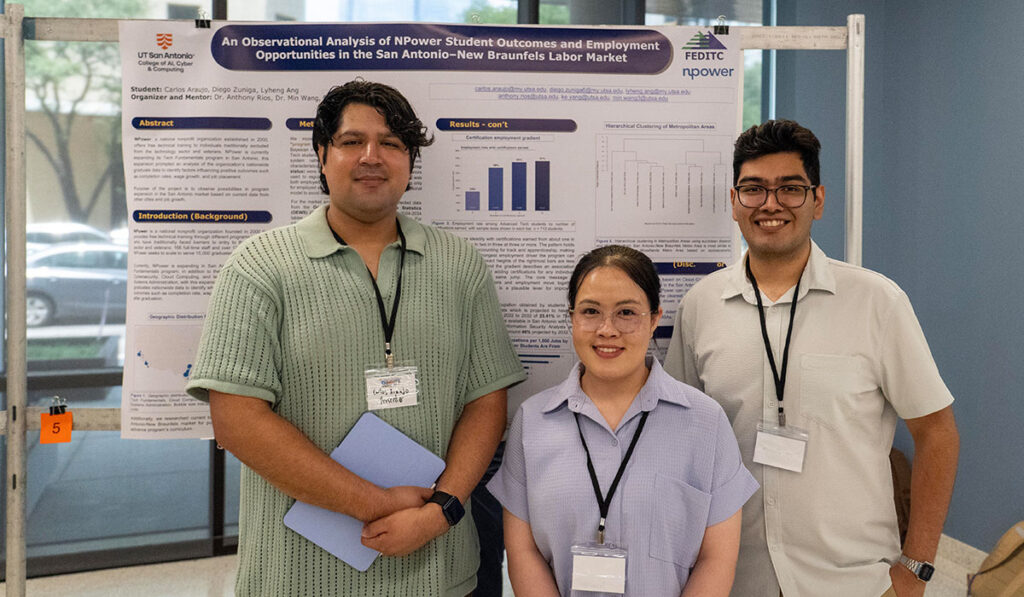
Student teams shifted their attention away from building predictive AI models and moved toward helping organizations understand and serve the people who rely on their programs. Working with NPower, a nonprofit technology workforce training organization, students analyzed more than a decade of enrollment, employment and certification data to identify factors influencing success in advanced technology pathways. The team found that apprenticeships were the strongest predictor of employment and that employment rates increased with certifications, said Lyheng Ang, a Master of Science in Data Analytics student on the NPower project.
The experience also provided a lesson in communicating technical findings outside the classroom, she said.
“In a classroom, we can talk technically to our audience, which is our classmates and professors; however, in the professional setting, we need to communicate with people from different backgrounds … translating technical findings for nontechnical audiences,” Ang said.
Another team partnered with the Fulton J. Sheen Apostolate to develop a digital platform supporting faith-based education and community engagement.
Students created tools to support scheduling, user profiles and website functionality while helping build a system that can connect participants with online and in-person small groups around the world.
“The broader goal is to also create a free world version of the organization’s prison-based Edovo program, allowing people in parishes and local communities to participate in the Fulton J. Sheen curriculum through both online and in-person groups,” said Periale Noutaha, a Master of Science in Economics student.
Noutaha said future work will analyze participant feedback to help the organization better understand how users engage with its educational content.

Beyond the classroom
In addition to building technical skills, students said the experience taught them lessons that extended well beyond the classroom. They worked with stakeholders, communicated complex findings to nontechnical audiences, navigated incomplete datasets and incorporated feedback throughout each project.
The experience also showed how student research can continue beyond the conclusion of a project. For Fry, the Headache Cure Board exceeded his expectations. He said his team’s findings could provide valuable information to the forensic and toxicology community, and the group is now exploring publication of its research.
“I never thought I’d work on a research project, and now we are talking about getting the study published,” Fry said.


