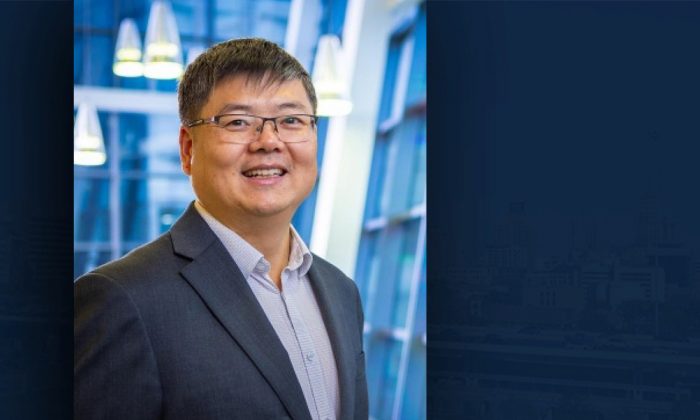
Nishant Vishwamitra, an assistant professor in the UTSA Department of Information Systems and Cyber Security has been awarded a two-year, $175,000 grant from the National Science Foundation’s Computer and Information Science and Engineering Research Initiation Initiative to combat cybersecurity threats such as cyberbullying, cyber harassment and online offensiveness by creating more effective content moderation systems for social media platforms.
Vishwamitra and his collaborators will develop machine learning techniques that can be trained using only a few samples of hate speech, called few-shot learning. The researchers hope that large social media platforms such as Facebook and YouTube will utilize their new tools to update the platforms’ hate speech moderation systems and address hateful content in a timelier manner. Vishwamitra’s goal is to reduce the psychological and social trauma that certain minorities and underrepresented groups face on online platforms.
“We believe that our methods pave the way forward to make online spaces safer from the negative effects of hate speech that are engendered by rapidly evolving events,” stated Vishwamitra, a faculty member in the Carlos Alvarez College of Business.
“This grant will help me recruit Ph.D. students to conduct experiments, pay study participants, and attend conferences and workshops to disseminate the findings that come from this research.”
Drawing inspiration from real-world societal issues, Vishwamitra’s research delves into the relationship between social cybersecurity and artificial intelligence (AI). His research focuses on how AI can address cybersecurity issues like hate speech and misinformation and how technology can exacerbate certain cybersecurity and social-cybersecurity issues.
Hate speech such as racism and antisemitism have commonalities, but the pandemonium escalated as the COVID-19 pandemic brought forth new waves of online hate in the forms of anti-Asian ideologies and ageism.
Vishwamitra joined the UTSA faculty in 2022 and teaches network security. He shares his knowledge of AI and social cybersecurity with underrepresented minorities and high school students through carefully developed, hands-on labs. He has developed six hands-on labs that are currently being implemented in other universities and high schools nationwide.
“We are also working on developing experiential learning educational materials, based on our work, that will train high school and college students to defend against new waves of hate,” he explained.
Additionally, Vishwamitra is working on projects that address the large-scale hate speech and mis/dis-information caused by large language models such as ChatGPT, educate students in the social harms of generative AI and explore how systematic biases affect the veracity of crowdsourcing.
“This grant will help me recruit Ph.D. students to conduct experiments, pay study participants, and attend conferences and workshops to disseminate the findings that come from this research,” he said.
Building on an undergraduate background in electrical engineering from India, Vishwamitra completed graduate studies at Clemson University and obtained his Ph.D. in Computer Science and Engineering from SUNY Buffalo State University.