

While students were cramming and faculty members were lecturing, UT San Antonio researchers stayed busy this year, testing novel ideas and pushing the boundaries of discovery.
Many of these efforts led to major breakthroughs, accolades and awards in 2025.
From imagining an opioid-free world of pain relief to forging computing systems that run on a fraction of the energy required in today’s systems, here’s how the university’s researchers have made headlines and set new records in the past year.
Making pain relief addiction-free
Texas is experiencing a “drug poisoning epidemic,” according to the Texas Department of State Health Services (DSHS), and opioids — some of the most dangerous yet readily available drugs on the market — are a predominant cause.
A team of researchers is actively developing safer, non-opioid medications to combat chronic pain while minimizing the risks associated with opioid use, including addiction and overdose.
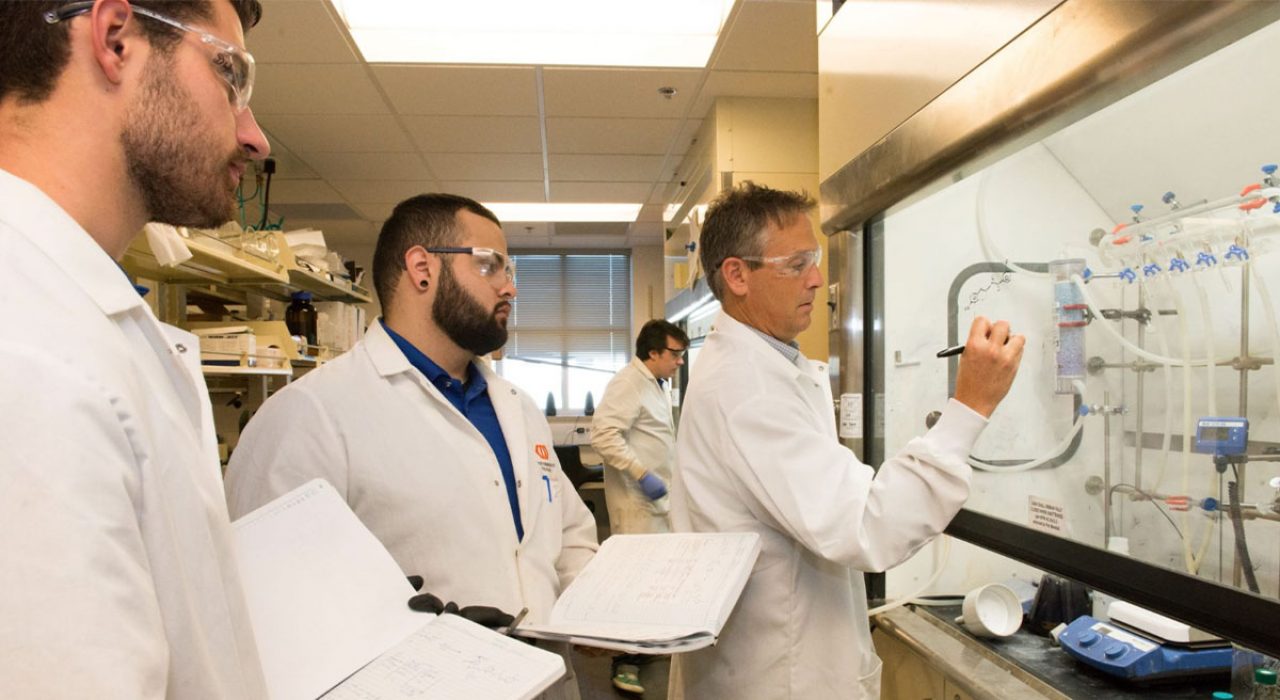
Led by Stanton McHardy, PhD, professor of chemistry and director of the Center for Innovative Drug Discovery (CIDD), the research involves three main approaches.
The first approach aims to prevent pain altogether, and subsequently, opioid disorder before it starts, and involves designing small-molecule inhibitors to block the pain-related PLA2 enzyme, a novel drug target developed by his UT San Antonio collaborator Ken Hargreaves, DDS, PhD, professor and dean of the School of Dentistry.
“Our collaborative research hopes to identify novel treatment options for millions living with chronic pain.” — Stanton McHardy
The second tactic works on reducing pain by targeting peripheral nerves. The research is focused on selectively activating the DOR-KOR heteromeric target, as opposed to the individual opioid receptors themselves.
McHardy’s UT San Antonio collaborators, Bill Clarke, PhD, distinguished teaching professor and Maharaj Ticku Professor of Pharmacology, and Kelly Berg, PhD, professor of pharmacology, have thoroughly characterized this novel pain target. The team is now working to discover small molecule agonists of the DOR/KOR heteromeric species. Reducing pain in this way could lessen the addictive risks associated with traditional opioids that act on the brain.
The third program centers on the compound CP612 (CIDD-0150612), which blocks the PKCε enzyme. The compound was discovered to be a key signaling enzyme in peripheral nociceptive sensory neurons by UT Austin team members Bob Messing, MD, and Micky Marinelli, PhD. This compound has shown promise in reducing nerve pain, specifically addressing chemotherapy-induced peripheral neuropathy (CIPN) and easing symptoms during opioid withdrawal.
All three projects are in various pre-clinical stages, ranging from molecular analysis and computational drug screening for the PLA2 and DOR-KOR targets to research studies and a publication in JCI Insight for the PKCε inhibitor CP612.
“Our collaborative research hopes to identify novel treatment options for millions living with chronic pain,” McHardy said.
Combating urban heat
The temperatures in dense urban neighborhoods can be hotter than surrounding areas due to the abundance of concrete, which, unlike green spaces, absorbs and radiates heat.
In San Antonio, 88% of residents live in “urban heat islands,” experiencing temperatures of at least 8 degrees higher than adjacent neighborhoods, according to Climate Central. That means that 100-degree days feel more brutal and come with increased danger of heat stroke.
One research team is tackling the problem of urban heat islands in San Antonio, specifically the city’s West Side.
With a $700,000 award from the National Science Foundation, Associate Professor Esteban López Ochoa, PhD; Assistant Professor Farzad Hashemi, PhD, and Wei Zhai, PhD (UT Arlington), are using AI to create digital twins, or virtual replicas, of individual homes.
This AI analysis helps determine what could be the most cost-effective and impactful repairs for specific homes to increase thermal comfort while using city resources as efficiently as possible. Using Hashemi’s environmental microsimulations, the team aims to generate what-if scenarios to determine scalable solutions to prevent heat-related health issues, especially in high-risk areas across South Texas.
The initiative is part of a broader suite of research projects and grants that have positioned UT San Antonio as an emerging voice in extreme heat readiness. These include a cool pavement evaluation led by Associate Professor Neil Debbage, PhD, and Professor Samer Dessouky, PhD, PE; a heat-plus-equity index to identify the hottest neighborhoods led by Assistant Professor Kristen Brown, PhD; a study assessing urban tree planting campaigns led by Assistant Professor Ryun Jung Lee, PhD, AICP, and an urban-sensing approach to assess housing conditions and evaluate extreme heat led by López Ochoa in conjunction with researchers from the Southwest Research Institute.
The City of San Antonio has used the research results to guide cool pavement product selection, prioritize the installation of heat mitigation measures in particular neighborhoods, as well as to educate residents and neighbors on the dangers of extreme heat to human health and the potential impact of housing repair.
Some homes they studied are 120 degrees indoors when the owners return from work, López Ochoa said. The team has so far assessed more than 600 residences.
Unveiling the pitfalls of vibe coding
The increasingly common practice of vibe coding — using AI tools to generate code in software development — comes with some serious risks.
A study led by UT San Antonio doctoral student Joe Spracklen delves into one critical mistake coders often make with AI and how cybercriminals can easily exploit the oversight.
While generating code, Large Language Models (LLMs) frequently reference software libraries that don’t actually exist. Hackers use this error, called “package hallucination,” to their advantage by creating a malicious package with the same name.
When an unsuspecting programmer executes their code, the program will import the decoy package, allowing malicious code into their system.
This strategy, called a “package confusion attack,” is not new, but the use of AI in programming has dramatically increased vulnerabilities to these attacks.
The team believes the most effective way to guard against these attacks is to improve the way LLMs operate. To help accelerate the change, they shared their findings with LLM providers, including OpenAI, Meta, DeepSeek and Mistral AI.
While providers are working to reduce hallucination, it won’t be an easy fix, Spracklen said.
“Hallucinations are an extremely difficult problem to fix, and it isn’t something providers can address with a simple patch,” Spracklen said. “It takes a deliberate effort during pre-training and training of the model, which now costs millions of dollars in computing power for the most high-end models.”
In the meantime, Spracklen believes vibe coding is here to stay, so coders must be vigilant.
“It’s simply impossible to deny the efficiency gains that have come with LLMs that can produce high-quality code very quickly,” he said. “But any time you code something and don’t fully understand how it works, there is an opportunity for a bad guy to manipulate or take advantage of that.”
The next generation of antibiotics
The frequency of antibiotic-resistant infections is on the rise and may have increased by as much as 40% between 2018 and 2023, according to the World Health Organization.
The global rise of antibiotic resistance has sparked an urgent search for new treatments, locking drug developers in an evolutionary arms race against adapting microbes.
Christopher Sandford, PhD, an assistant professor of chemistry at UT San Antonio, is spearheading a project to accelerate the discovery of new drugs, particularly antibiotics, by using light to precisely control chemical reactions.
With support from the National Institutes of Health, Sandford’s team is developing a specialized “switchable organometallic catalyst” that responds to different wavelengths of visible and ultraviolet light.
The global rise of antibiotic resistance has sparked an urgent search for new treatments, locking drug developers in an evolutionary arms race against adapting microbes.
The approach is designed to overcome a significant hurdle in automated parallel synthesis, a technique in which chemists simultaneously create and test many variations of a drug molecule. The challenge lies in controlling the reactions to ensure modifications occur only at targeted spots on the molecule.
By using light to activate the catalyst, researchers can trigger specific chemical transformations with unprecedented precision, accelerating progress.
“Each time we build an organic molecule to test for medicinal properties, we typically use a different reaction with completely different conditions for each step, requiring isolation of each intermediate in what could be five to 10 steps,” Sandford said. “With this technology, we are hoping to iterate multiple bond formations in sequence to rapidly build molecules in one pot.”
Driving the neuromorphic revolution
A team of researchers, led by MATRIX AI Consortium Founding Director Dhireesha Kudithipudi, PhD, published a comprehensive review in Nature titled “Neuromorphic Computing at Scale,” charting the future course for this brain-inspired technology.
Neuromorphic computing, which mimics the structure and function of the human brain, has the potential to create systems vastly superior to traditional computers in terms of energy and space efficiency.
The technology could address a crucial challenge, as the electricity consumption of data centers is projected to double by 2030.
While existing systems are rapidly growing — like Intel’s Hala Point with over 1 billion artificial neurons — the team stresses they must scale up considerably to tackle complex, real-world challenges in fields like AI, healthcare and robotics.
Kudithipudi and her colleagues are putting theory into practice with THOR: The Neuromorphic Commons, the largest-ever full-stack neuromorphic platform to be open to the public.
When the platform officially launches in January, researchers from UT San Antonio and across the United States will be able to request access to THOR to test a range of apps and programs.
The team hopes that THOR will democratize access to the novel technology and also promote standardization and interoperability, ultimately paving the way to mainstream use.


