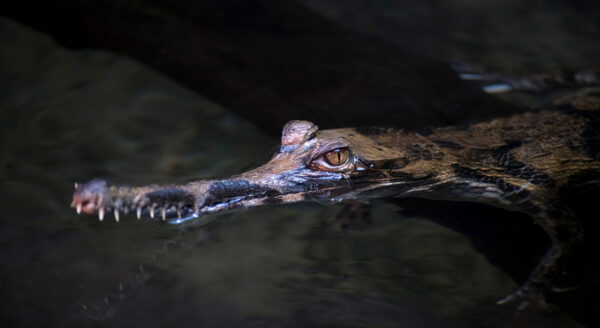
In the dense, blackwater peat swamps of Southeast Asia, a rare predatory reptile conceals itself below the water’s surface, largely unknown to the world.
The Sunda gharial (Tomistoma schlegelii) is a crocodile that is dwindling in numbers, but Kyle Shaney, an assistant professor of vertebrate zoology at UT San Antonio, is leading an important mission to uncover its mysteries.
Listed as endangered on the International Union for Conservation of Nature’s Red List, the Sunda gharial is one of the world’s least understood crocodilians.
Historically ranging across Borneo, Sumatra and peninsular Malaysia, the species faces mounting pressure from habitat loss — driven in part by rainforests being converted to oil palm plantations — as well as accidental capture in fish traps.
“This is one of the least-studied crocodilians in the world,” Shaney said. “There’s still much about their ecology that we know nothing about.”
Conservation efforts to support the Sunda gharial could have a powerful ripple effect, protecting hundreds of other endangered or lesser-known species in the region.

Giant in the shadows
The Sunda gharial, often called the “false gharial,” is a massive reptile that can reach lengths of 17 feet or more.
Unlike its fish-eating relatives in India, this species is a generalist predator, known to hunt monkeys and wild pigs in the remote swamps. However, unlike the more prevalent saltwater crocodile, the Sunda gharial is generally not aggressive toward humans.
Despite its size, the gharial is a master of camouflage. Its body features a complex pattern of brown, black and yellow that blends seamlessly with the dark swamp waters.
Their elusive nature, combined with their sparsity, makes finding them a challenge, often requiring Shaney and his team to conduct surveys by boat at night, using spotlights to catch the reflection of the animals’ eyes.
“It’s one of the parts of the job that I love the most, those nighttime surveys,” Shaney remarked. “You’re just floating through these jungles at night. You can hear all the sounds of the insects … it’s a totally different world.”
Unlocking genetic secrets
A critical component of Shaney’s research, funded by the conservation group CrocFest, involves analyzing the genetic diversity of wild populations.
Because the crocodile populations have been isolated on different islands like Borneo and Sumatra for at least 10,000 years, Shaney believes there may be unique lineages or even entirely distinct subspecies that have yet to be identified.
“There’s potentially some very unique lineages; we would have to describe those,” he said. “They would likely be critically endangered, and we don’t even know it because nobody has ever looked at the genetics in this species.”
“If you have low genetic diversity, then the species is more likely to go extinct,” Shaney added.
Conservation beyond one species
The research aims to do more than just save a single predator.
Shaney refers to the Sunda gharial as a “flagship species,” meaning that protecting its habitat inherently protects the entire ecosystem — including other endangered wildlife like the Sumatran tiger and clouded leopard.
“By protecting these blocks of habitat from deforestation, we will ensure that those species do not go extinct — including insects, plants, birds and probably species that haven’t been discovered yet,” Shaney said.
Shaney will work with a team of experts that includes U.S.-based researchers Matthew Shirley of Florida International University, Chris Murray of Southeastern Louisiana University and Kent Vliet of University of Florida, as well as Indonesia-based scientists from the National Research and Innovation Agency, Amir Hamidy and Awal Riyanto.
Several local and indigenous staff also support the fieldwork regularly, including Kasno, Sismanto and Andi (no surnames), who have been working with Shaney for over a decade, guiding and assisting with trip logistics in Berbak National Park.
The team plans to produce a comprehensive report and publication within the next 18 months, sharing findings that will help identify high-priority areas for protection and guide future conservation strategies across the Sunda region.