


Twelve years ago, conditions and morale at Irving Academy in the San Antonio Independent School District (SAISD) were abysmal, according to teachers and district leaders.
“You could smell the mold that was in the carpets. There were no windows in the classrooms,” said Jackie Calderón Hernandez, a teacher in the middle school English Language Arts class.
Since then, the district has cleaned up the buildings and made significant strides in improving the school, and, through a program called the Dual Language Community Lab Schools Partnership, the district now contracts with UT San Antonio to operate the campus.
Today, Irving is among the highest-rated schools in the district. This benefits not only the students at Irving, but also the UT San Antonio students who can visit, teach, conduct research and learn from the campus.
New renovations and name
Hernandez began working at Irving in 2014 when she attended a job fair and was hired on the spot. She was among a wave of new hires, including administrators, that the district brought in to turn the languishing middle school around. Despite these efforts, in 2017, the Texas Education Agency (TEA) gave Irving a rating of “Improvement Required,” or in today’s terms, an F.
In the years that followed, Hernandez watched as numerous concerted attempts at rehabilitating the middle school failed, one after the other.
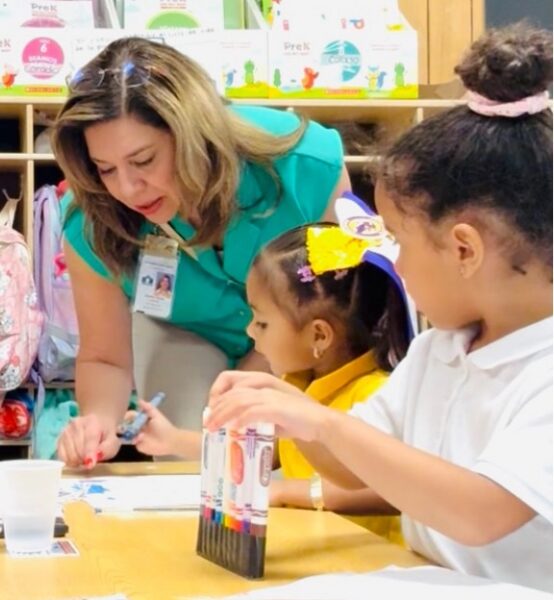
Then, in 2017, new school leadership removed the carpeting, installed windows and began admitting students as young as preschool-age to the newly renovated and renamed Washington Irving Dual Language Academy.
Beyond the facility improvements, a vital step forward, the district also transformed the curriculum to embrace bilingual education. About half of Irving’s student population came from Spanish-speaking households and half from those speaking English most of the time.
The dual language curriculum encouraged students starting in Pre-K to speak Spanish 80% of the time, then gradually shift the balance until there was an equal split between Spanish and English.
To help bridge language gaps, English and Spanish-speaking students were often paired with one another for assignments.
The new curriculum meant that Spanish was a valid vehicle for discovery and expression in the classroom, not a “bad habit” to be stamped out in remedial English as a Second Language (ESL) classes.
“That’s very important because [Spanish-speaking students] are now a part of the school,” Hernandez said. “They’re part of the community. They don’t feel like, ‘oh, I’m in this separate class while the rest of the school does other things.’”
Spanish-speaking students no longer felt sidelined because everyone spoke English and Spanish, she added.
“There is a palpable sense of pride in bilingualism throughout the school community,” said Juanita Santos, executive director of the partnership. Santos noted that the principal uses Spanish throughout the day, setting a positive example and “reinforcing the campus’ commitment to linguistic and cultural affirmation.”
In 2025, the TEA awarded the academy an A rating — a testament to the transformative impact of those changes.
Working in tandem
Irving is one of four campuses in SAISD leveraging a dual language system with support from UT San Antonio.
The others are James Bonham Academy, Mark Twain Dual Language Academy and Charles Graebner Elementary School.
With grant funding through Senate Bill 1882, the Dual Language Community Lab Schools Partnership is now in its fifth year. Through the program, SAISD contracts with UT San Antonio to operate their campuses.
The symbiotic relationship provides K-12 classes where teachers-in-training in the university’s College of Education and Human Development (COEHD) can observe, teach and conduct research. In exchange, the college provides expertise, training and teaching residents, who work in the Irving classrooms alongside full-time teachers.
Santos, who oversees the partnership, continually works with the principals and teachers in the schools to fine-tune the program. She conducts weekly walkthroughs with administrators, talks with teachers, and then gathers input from faculty in the Department of Interdisciplinary Learning and Teaching to address challenges, often in the form of teacher training. One training session was so popular at the dual language schools that the district hired the department’s professors to train the rest of the Pre-K teachers across the district.
The partnership also fuels research at UT San Antonio, Santos said.
“We’ve had professors at the university who were interested in having that immediate access to students to pilot their ideas,” she said.
For example, Felicia Castro-Villarreal, professor of educational psychology, brings her graduate counseling students to the schools to partner with teachers.
“Students apply what they learn in their course by collecting data and implementing behavioral strategies, gaining practical experience while also contributing to the campus,” Santos said.
“It provides students with authentic, real-world contexts that make research more relevant, impactful and directly applicable,” she added.
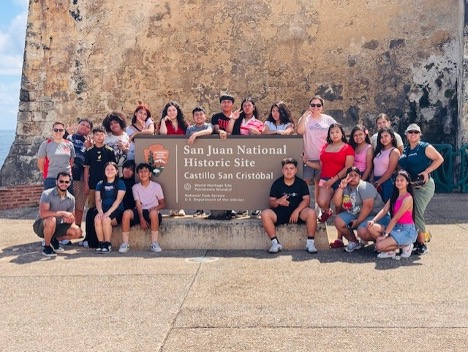
The benefits of the program also extend beyond the classroom. Eighth-grade students can spend spring break in Puerto Rico, where they learn about Latin culture and experience Spanish immersion.
“This is an experience students will always remember,” said Santos, noting that some students have never left San Antonio or flown on a plane. “It’s an extraordinary opportunity.”
Teachers of tomorrow
Angelica Nieto participated in the teaching residency program at Irving last year, as she finished her bachelor’s degree with a focus on bilingual literacy.
The drive to teach came from her own educational journey. Nieto arrived in Nebraska as a Spanish-speaking child and didn’t always receive the support she needed to acclimate and thrive.
“I was a sink-or-swim student. Either you sink or you swim, knowing or not knowing English,” she said.
But her teachers helped motivate her to keep trying.
“Some of my teachers really believed in me, and that was the reason I would go to school,” Nieto said. “I think that if it hadn’t been for some of my teachers, I probably would be in a very dark place right now.”
Nieto hopes to give that same crucial support to her students.
“I really want to be able to make an impact on students who are living the childhood that I had,” she said. “If I could just reach out to one and have an impact on just one student, I think that I could change the world.”
The district has pre-hired Nieto to teach starting in August. While there’s no guarantee she will be placed in one of the dual language academies, Nieto is hopeful. After experiencing firsthand the stress of the “sink-or-swim” model, Nieto is a firm believer in bilingual education.
“Dual language programs are important because they honor students’ home languages while preparing them for a bilingual world,” she added.


