


This story is part of a series highlighting the university’s outstanding graduates crossing the stage on May 16.
For all her life, Julia Enriquez has been surrounded by people with a heart of service.
She grew up witnessing her grandfather, Hector Morales, protecting the city’s waterways by serving on the board of the San Antonio River Authority.
Her father, Roger Enriquez, ’98, JD, associate professor of criminology and criminal justice at UT San Antonio and executive director of the university’s Westside Community Center, has always been an advocate for San Antonio’s District 5, the community where he grew up.
So, it’s no surprise that Julia, who is also Miss Fiesta San Antonio 2026, has always felt in her heart the urge to lend a hand to those who need it.
A senior politics and law major in the Honors College, Julia is passionate about creating affordable housing opportunities, establishing generational wealth and empowering her fellow community members — many of which reside in the city’s Westside, the same neighborhood where she attended St. John Bosco Elementary School, took dance classes at the Guadalupe Cultural Arts Center and had her quinceañera.
Julia has spent the last year working at the Mexican American Unity Council (MAUC) as legal assistant and housing “promotora.”
“I help people clear titles to their homes. I always say it’s a very niche kind of love, but it’s very necessary,” she said. “A lot of people have generational housing, and as they pass it down, they don’t realize that their great grandmother is still on the title. It’s important that we clear your title because it preserves generational wealth. These homes are where all the memories are, so the fact that I get to help people save their homes is a privilege I don’t take lightly.”
Julia ensures these housing title issues don’t happen again, especially after the homeowner passes away. She said she was inspired by her father, Roger, who saw this problem persisting in the District 5 neighborhood.

“We wanted to know why there were so many vacant lots in District 5,” Roger recalled. “The City of San Antonio actually keeps an inventory of all the vacant lots. If you randomly select a certain number through probability-based sampling, you can actually come up with a very good reason as to why that is. We found that something like 80% of those vacant lots didn’t start out as vacant lots. In fact, the vast majority of them had, at one point, a home, but issues arose with clouded title, the problem is common, especially if someone died without a will.”
Roger continued to explain: “The title then became what we call ‘heirs’ property.’ So, the title gets diffused to all these different folks — somebody who lives there but maybe doesn’t pay the taxes or doesn’t fix the house. Eventually, it creates a sort of a downward spiral … and sadly, in many of those instances, the house gets demolished.”
Through the Westside Community Center, which UT San Antonio established in 2019 to provide community services and programs for Westside residents and businesses, Roger established a relationship with the Mexican American Unity Council.
“They had housing counselors that were already embedded in the community. And something that I realized very quickly is that they had tremendous cultural competence when dealing with folks on the Westside,” Roger said. “They weren’t judgmental like some attorneys I’ve dealt with. The folks at MAUC said they need to hire people who have the desire to help the community and I said, ‘Well, I think I might know somebody.’”
Julia added that it is the greatest privilege of her life to help residents.
“I think not helping would be a very ignorant and selfish thing to do,” she said. “It’s been instilled in me by my dad—by my parents. It’s extremely important to me to help those who come in and to provide legal education.”
While working at MAUC, Julia has seen firsthand many of the barriers these residents face, such as not speaking English or lacking digital literacy. However, she had plenty of experience in providing assistance to meet these needs.
“When I used to work in the Westside Community Center, and helped with the San Antonio’s home rehab program, a lot of the people who would come in did not know how to work on a computer, and a majority of the applications were found online,” she explained. “In order to apply, you also need to have an email address. You need to upload bank statements. You need to figure out how to find all of these things and make copies of them. A lot of them didn’t know how to do that.”
Julia would schedule people in 30-minute intervals to help them set up email addresses, upload documents and teach them how to use their smartphones for the future.
“I also helped some people apply for the Social Security,” she added. “I thought it was very neat because I was 18 years old at the time and these people entrusted me with that kind of responsibility.”
In addition to her work with MAUC, Julia became a research assistant this semester to Ryun Jung Lee, PhD, AICP, assistant professor in urban and regional planning, and is helping conduct research on affordable housing in San Antonio.
“Affordable housing is something that I’m very passionate about. I love San Antonio and I want to stay here,” Julia said. “However, the city is growing, which is amazing, but at the same time, housing costs are rising. Getting to conduct this research is a great opportunity because I can become educated about something I’m not super familiar with.”
Over the next year, while Julia works at MAUC, assists with affordable housing research, finishes her undergraduate studies at UT San Antonio and starts her law degree at St. Mary’s University, she will also be serving as Miss Fiesta San Antonio 2026. Miss Fiesta serves as the official ambassador of the San Antonio Fiesta Commission and its 100 nonprofit member organizations.
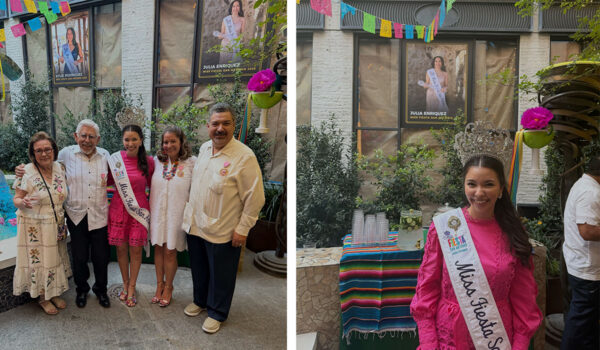
“I help promote their events to make sure that word gets out so that we’re able to give back to the community in that way,” Julia said.
She hopes to continue working in the nonprofit world where she can practice estate planning or probate law with San Antonio residents.
“I would like to either keep working at MAUC and build a strong partnership there with the nonprofit to expand the free legal services that we offer, or I’d like to eventually start my own nonprofit,” she said.


