In San Antonio, Christopher Mao is preparing to start his internal medicine residency in the same city where he trained.
“Texas has shaped every stage of my life,” Mao said. “I was born and raised in Houston, studied in Austin, and trained in San Antonio. Staying here for residency gives me the opportunity to give back to the communities that have invested so much in me.”
Brooke Heche will soon begin her career as a labor and delivery nurse after commissioning as a second lieutenant in the U.S. Air Force and describes a similar pull to stay in the city.
“Texas, and especially San Antonio, has shaped both who I am and the nurse I am becoming,” Heche said. “I know I’m a stronger, more capable nurse because of the patients, families, and teams who have poured their wisdom and encouragement into me.”
Experiences such as these are becoming increasingly common in Texas, an encouraging shift as the state faces persistent healthcare challenges. With shortages in primary care, mental health, and dental services, the need for a strong, sustainable healthcare workforce has never been more urgent.
More than 80% of Texas counties are designated mental health shortage areas, and about 40% lack sufficient primary care access. In rural communities, the challenge is even more pronounced as nearly every rural county faces health professional shortages.
State projections estimate Texas could face a shortage of approximately 10,000 physicians by 2032, driven by population growth and an aging workforce.
Closing the gap requires a workforce built and retained close to home.

A workforce that stays
The university produces more than 1,100 graduates annually across medicine, nursing, dentistry, allied health, biomedical sciences, and public health, forming one of Texas’s largest pipelines of practice-ready clinicians.
Nearly 90% of School of Health Professions graduates enter the Texas workforce, along with 94% of Bachelor of Science in Nursing graduates, 88% of doctoral nursing graduates, and 81% of new dentists. Among physicians, 61% continue their residency training in Texas.
“Graduate retention is one of the most meaningful ways we fulfill our mission to serve the public good,” said Francisco G. Cigarroa, MD, UT San Antonio’s senior executive vice president for health affairs and health system. “When physicians, nurses dentists, allied health professionals, scientists and public health leaders choose to build their careers here, it strengthens the health and future of Texas by expanding access to exceptional care closer to home, advancing discovery, and improving lives for families and communities across our state.”
Designing a workforce for Texas
At UT San Antonio, workforce development is structured as a coordinated system that begins early and continues well into a graduate’s professional practice.
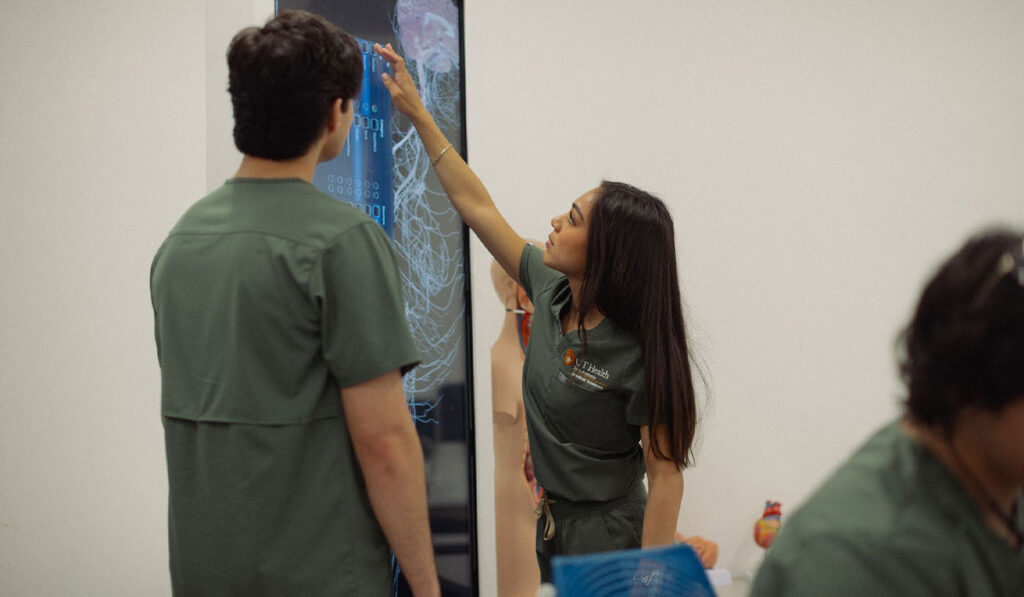
Through undergraduate pipeline programs, many students are recruited from under-resourced communities, supported throughout their academic journey and trained in real-world clinical settings across Texas.
Long-standing partnerships with University Health System, the university’s foundational and primary clinical and teaching partner, the South Texas Veterans Health Care System (including the Audie L. Murphy Memorial Veterans’ Hospital), federally qualified health centers, and community organizations create a seamless pathway from classroom to clinical practice. Together, these partnerships strengthen the quality of care delivered across South Texas while building the healthcare workforce our region and state depend upon.

Students gain hands-on clinical experience in diverse care settings and progress into advanced training opportunities, often continuing their education and careers within the same health systems. These integrated clinical pathways not only prepare graduates to deliver exceptional patient care but also create a strong talent pipeline that helps meet the growing demand for highly skilled healthcare professionals.
The impact is evident. Since 2017, 100% of nursing students accepted into the VA Student Trainee Experience Program have received employment offers within the VA system following graduation. After one year, 100% of those hired remained with the VA, and 89 percent remained after three years, demonstrating how structured clinical education partnerships translate directly into workforce recruitment, retention, and long-term stability.
Support systems also reinforce continuity. Peer mentoring, academic support centers, and faculty-led mentorship programs help students transition confidently into their professions.
Across its health professions programs, UT San Antonio students consistently outperform national benchmarks on licensure and certification exams, demonstrating exceptional preparation to serve patients and communities across Texas.
At the Joe R. and Teresa Lozano Long School of Medicine, 98% of the Class of 2026 matched into residency programs, surpassing the national average. The School of Health Professions achieved a 99% pass rate across its programs. The School of Nursing, ranked among the top 11% of Bachelor of Science in Nursing programs nationally by U.S. News & World Report, recorded a 95 percent first-time pass rate on the National Council Licensure Examination. At the School of Dentistry, ranked No. 1 in Texas and No. 9 nationally, students continue to demonstrate extraordinary outcomes, including near-perfect pass rates on national board examinations. These results reinforce the school’s reputation as one of the nation’s premier institutions for dental training.
UT San Antonio also offers advanced degree programs, residencies, and continuing education designed to help health professionals deepen their expertise while remaining in practice.

A healthier future
In May 2026, the Kate Marmion School of Public Health graduated its inaugural class, marking an important milestone in strengthening the public health workforce for San Antonio, South Texas, and rural communities across the state. As the only locally based school of public health in San Antonio, it prepares future leaders in disease prevention and population health for communities throughout the region.
In just its third year, the school has already earned a top national ranking for research funding, reflecting the demand for its graduates and the growing role of public health in reforming the future of care.
Listen to the impact of the Kate Marmion School of Public Health.
Each physician, nurse, allied health professional, and oral healthcare provider contributes to improved health outcomes, but also to economic stability by creating jobs and reducing the cost and complexity of recruiting talent from outside the state.
“Preparing the next generation of health professionals is fundamentally about strengthening the future health and well-being of Texas,” Cigarroa said. “When we educate and train talent within our own communities, we create a lasting foundation for exceptional care, expanded access, and healthier populations across our state. Our responsibility is to advance excellence in education and healthcare while ensuring future Texans benefit from exceptional care, discovery, and service for decades to come.”