


A UTSA team of researchers is working to preserve the legacy of some culturally significant home properties in San Antonio because they could also help alleviate the local housing affordability crisis.
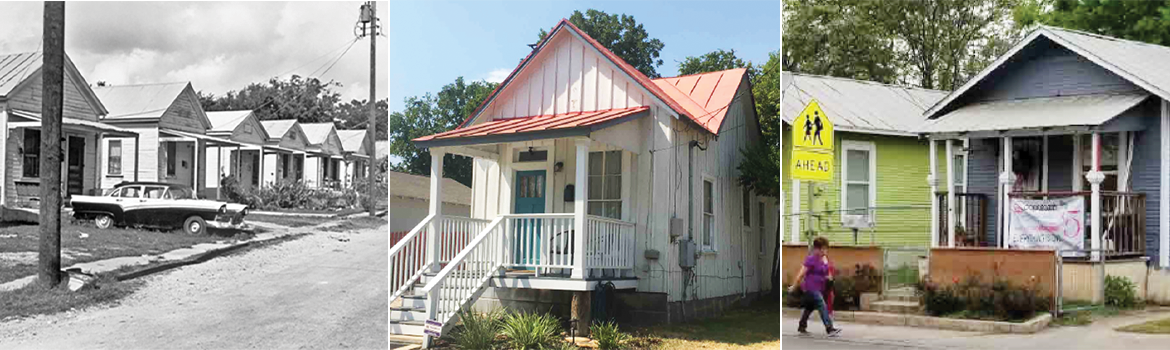
According to “Opportunity at Risk,” an affordable housing study commissioned by the city’s Office of Historic Preservation, there is an estimated 33,000 of these houses, each 1,000 square feet or smaller, built in the city prior to 1960. Several hundreds of these homes are “shotgun” houses, known for their narrow depth.
The team, led by Roger Enriquez, executive director of UTSA’s Westside Community Partnerships and an associate professor of criminal justice in the College for Health, Community and Policy, in collaboration with Angela Lombardi, an associate professor in the Department of Architecture, will help will help a team of city departments and NGOs to demonstrate that shotgun houses can be rehabbed at an affordable cost using a mix of funding sources. The team is working under the direction of District 5 City Councilwoman Shirley Gonzales.
Councilwoman Gonzales and her team selected the properties to be rehabbed from a short list provided by the Office of Historic Preservation. The OHP culled the list from a citywide inventory the city department conducted. The OHP worked with Lombardi’s class to develop a methodology to better understand culturally significant properties. Lombardi noted shotgun houses are especially prevalent on San Antonio’s West Side, giving the neighborhood its unique cultural landscape.
“The Shotgun Houses Project in District 5 is the kind of bold initiative that our community needs to preserve history and culture.”
UTSA launched the Westside Community Partnerships Initiative in 2019 to help shape educational, economic and cultural programs and services for individuals living and working on the West Side. Citywide partnerships are necessary to tackle the community’s concerns over housing, poverty, low educational attainment and lack of internet access.
“These small dwelling units are a vivid historical remnant of redlining practices in the urban core,” said Enriquez. “Often the original owners could not find financing from financial institutions, so they purchased and built them as part of kits from local lumberyards.”
Enriquez explained the importance of shotgun houses for preserving affordability: “One of the most often overlooked contributors to affordability is home size—the larger the home, the more expensive it is.”
This collaboration between UTSA, the City of San Antonio, small contractors and Community Development Financial Institutions will help preserve an important part of the city’s cultural history on the West Side.
“The Shotgun Houses Project in District 5,” Gonzales said, “is the kind of bold initiative that our community needs to preserve history and culture, provide needed housing and use the community’s resources to build a stronger economic structure. Our vision is to prove a community development concept and expand it to other parts of the city.”
Enriquez added, “More than 58% of all households in San Antonio are composed of one person or two persons. For many of these households a shotgun house could be a good option. Preserving shotgun houses should be a public policy priority to help mitigate increases in home values.”
“This venture can serve as a demonstration project for other preservation initiatives,” said Sedef Doganer, chair of UTSA’s Department of Architecture.
The Shotgun House Project is expected to have three home renovations completed by April 2021.


